Day 5 of 5: deployment
Day 5 of 5. Deployment.
Merging is done by a script. The agent that wrote the change doesn't get to press the button. Once it ships, the live system has to report healthy, and then someone checks it working again in the real environment. After that comes the clean-up, where a finished piece of work frees its worktree, its branch and its test data. Half-finished work that never lands costs more than the tokens ever will.
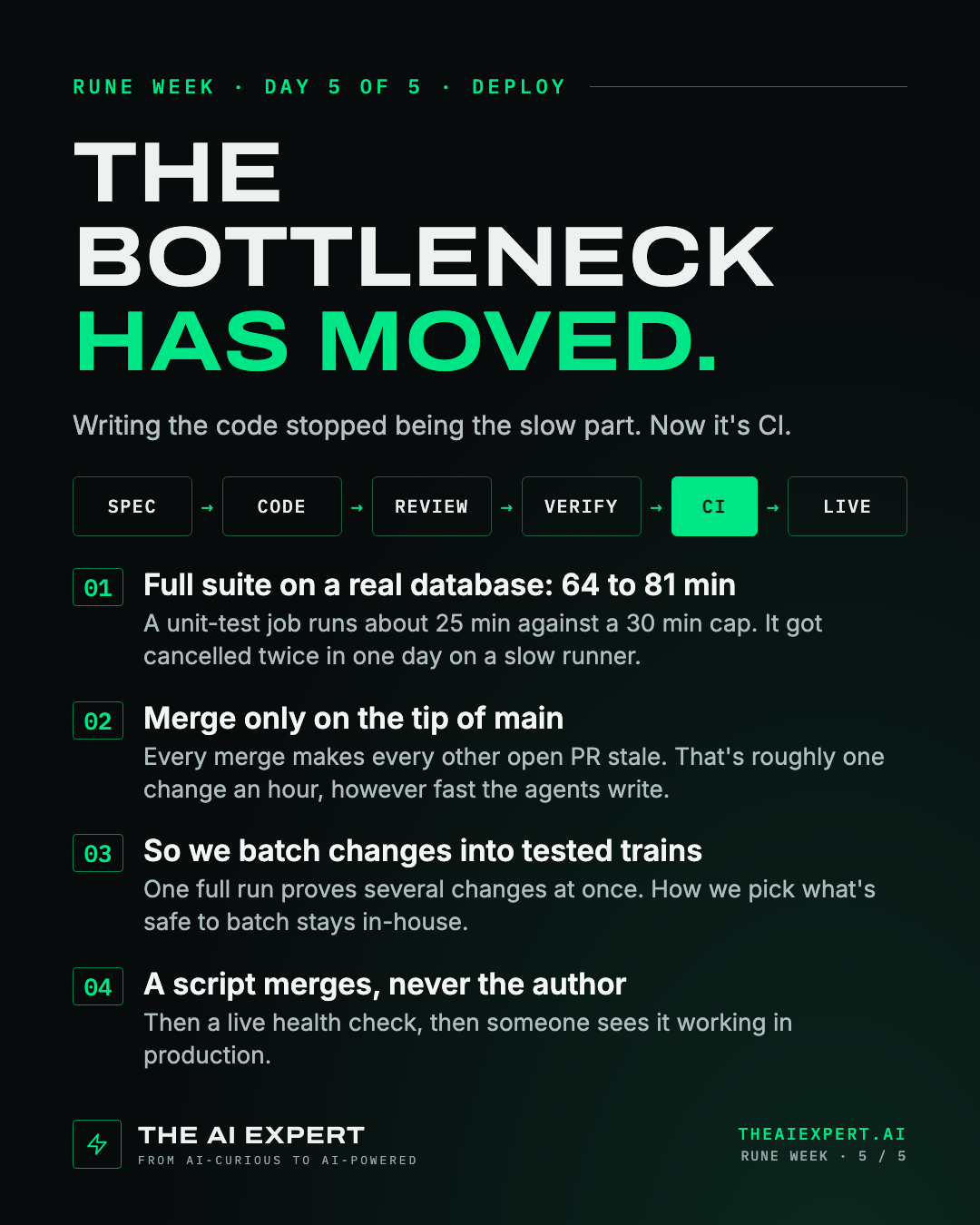
The thing that surprised me this year is where the bottleneck went. My bottlenecks are now on the CI side.
On one project the full suite against a real database takes 64 to 81 minutes. A change can only merge once it's been tested on the tip of main, so every merge makes every other waiting PR stale, and you land roughly one change an hour however fast the agents write. Elsewhere a unit-test job runs about 25 minutes against a 30-minute cap, and on a slow runner it got cancelled twice in one day.
So we batch changes into tested trains, where one full run proves several changes at once. How we decide what's safe to put on the same train I'm keeping to myself for now.
How long does your slowest required CI check take, and what have you done to get around it?